Sunday, March 2, 2008

"One should absorb the colour of life."

I've been talking alot about John Everett Millais and his work, but one should give credit where credit is due. Many people who claim to be "art people" or "literature people" often do so to avoid being a "science person" or a "math person". In fact, we all often forget that all the subjects and intricately intertwined in each other. For example, one cannot be a "literature person" and brag about how many books/pages they've read, or use a particularily pretentious vocabulary due to the amount of words they know. I mean, that's math.

And art, oh art would be nothing without the advancements science has made in the art process. So, right now we're going to switch gears entirely and talk science (with a little poetry included so I'd better get some snapping) (Okay, not really).

The world is full of colors, and every day artists attempt to replicate these bright beautiful hues into portraits of our beautiful world with a little touch of creativity. But how to take the yellow gold of a sunflower and show the way the sun illuminates its petals on paper? How to take the deep blue of the tempestuous sea with the white, glistening foam of its waves and paint it onto a canvas? The answer lies in pigments, and the chemistry of paint.

Most paint is composed of four main components: liquid, additives, binders, and pigment. Each of these components plays an important role in achieving the smooth and finished look of the final product. In Chemistry, the liquid of the paint would be known as the ‘solvent’. The solvent is a substance in which other substances are dissolved. It is important to use the proper solvent when making paint, because with the right one, it provides the desired consistency and is responsible for allowing the pigment and the binders to stick to the desired surface.

So that was your chem lesson for the day, and I'll post more about the science behind art at a later date.

.....

But if you simply must have a history component as well I'll give you a quick one (with a little science involved, ha):

Nowadays you can find everything you need to become your own closet artist at your local art supply store. But it wasn’t always this way. The art of painting dates back to the days of the cave man, and what has affectionately come to be known as ‘cave paintings’. But what some of the art world dismisses off as simplistic and plain there is much more to then what meets the eye. Traditionally it has been assumed that the cavemen got their pigments from animal and plant sources. But more and more is being discovered about these cave dwellers every day, and though animal and plant pigments were utilized, the paintings that have lasted for thousands of years came from iron oxide deposits in the earth. The caveman must have known this, and continued to express himself with the ingredients that would not fade with the changing environment.

And a word to Geico:

Please, it's getting way past ridiculous.

Speaking of ridiculous, lets end this post on a reflective note:

1937:



2006:


These are both really bad pictures but to get a better idea of what I mean, go look at the Disney logo on "Snow White", and then check it out on the newest Disney movie you have and you'll see what I'm referring too.

"Whenever people agree with me I always feel I must be wrong."

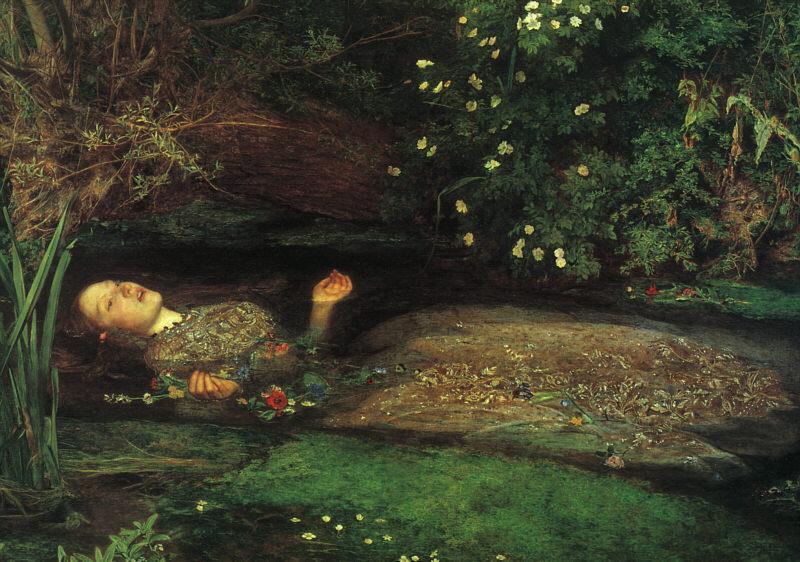
Millais' "Ophelia" might be one of the modern day best and most well known representations of the character, but as I have said (briefly) before, critics at the time throughly hashed the painting.

While painting "Ophelia", Millais' behavior was not that of the modern artist of the time. For one thing, he spent more time on the background of the painting then the actual subject (which wasn't the practice of most artists of the time). He spent time out in Ewell (around 35 miles from London) searching for the perfect place to paint his background. He finally found a spot beside a river, and as he was painting, was picky about things such as the particular flowers that went into it, so that they would be easily recognizable to the viewers, and would reflect the ones mentioned in the play:

QUEEN GERTRUDE

There is a willow grows aslant a brook,
That shows his hoar leaves in the glassy stream;
There with fantastic garlands did she come
Of crow-flowers, nettles, daisies, and long purples
That liberal shepherds give a grosser name,
But our cold maids do dead men's fingers call them:
There, on the pendent boughs her coronet weeds
Clambering to hang, an envious sliver broke;
When down her weedy trophies and herself
Fell in the weeping brook. Her clothes spread wide;
And, mermaid-like, awhile they bore her up:
Which time she chanted snatches of old tunes;
As one incapable of her own distress,
Or like a creature native and indued
Unto that element: but long it could not be
Till that her garments, heavy with their drink,
Pull'd the poor wretch from her melodious lay
To muddy death.


Let us also keep in mind that painting outside was also very uncommon back then.

A few quotes from critics:

“Yet what misconception so ever may characterize these works, they plainly declare that when this painter shall have got rid of the wild oats of his art, with some other vegetable anomalies, his future promises works of an excellent, which no human hand my have yet excelled".

"The open mouth is somewhat gaping and gabyish,--the expression is in no way suggestive of her past tale. There is no pathos, no melancholy, no brightening up, no last lucid interval. If she die swan-like with a song, there is no sound or melody, no poetry in this strain."

Friday, February 22, 2008

"Art is the most intense mode of individualism that the world has known. "

Since I'll be looking into John Everett Millais more, I'll be posting a helpful links from time to time:

Small gallery of his work

I thought this piece was interesting. It's titled, "The Bridesmaid" and was painted around the same time "Ophelia" was in 1851. She seems to have an almost holy look to her, innocent yet sad. Maybe it ties in to the expression "always a bridesmaid, never a bride."

I also like this one and this one.

After looking through the paintings, I find it interesting that he can paint such stoic , almost statue-like portraits, and yet put so much life into to his other work.

Wednesday, February 20, 2008

"A work of art is the unique result of a unique temperament."

As I've mentioned before, I shall be posting research on Sir John Everett Millais, and his painting "Ophelia".

Naturally, Millais is not the only one who has painted this tragic femme.

Other artist and their portrayals include:

Joseph Severn

Richard Redgrave

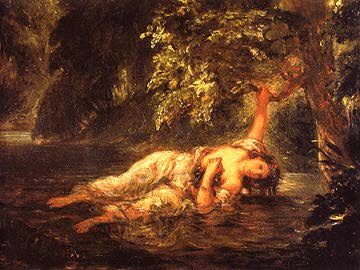
Eugène Delacroix (though he is most well known in the art world for this.)

James Sant

George Frederic Watts

Madeleine Lemaire

(For a complete list, check out this site)

SO WHO'S YOUR FAVORITE???

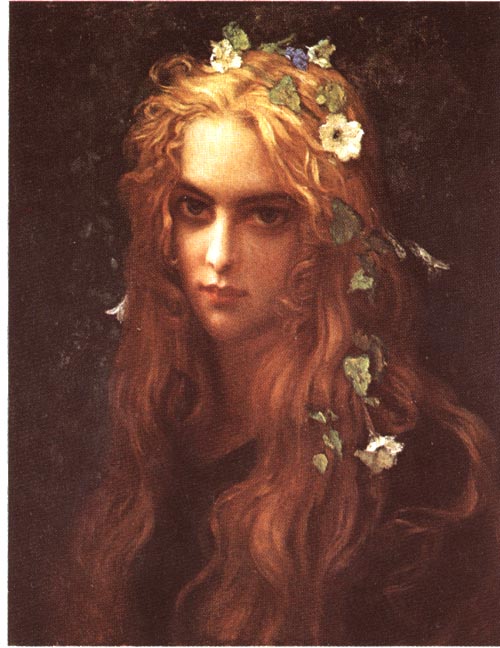
I'd have to say my favorite (so far) is Ernest Hébert's portrayal:


And the striking black and white version:


This Ophelia isn't you common poster child for flower seeds and helplessness; the flowers seem hang on to her, not the other way around. She projects emotion, depth, darkness, and sexuality through her piercing stare that speaks silently of a deep pain inside.

"A little sincerity is a dangerous thing, and a great deal of it is absolutely fatal."

Perhaps if Ophelia had somehow pondered this thought before she went and drowned herself a whole chain of events that led to the climatic ending that is Hamlet, Prince of Denmark might have been avoided (and in consequence, a bunch of people might still have been alive by the end of the play.)

At any rate, Shakespeare, another notorious author like our very own Oscar, is infamous in the arts and literature settings alike. His works are perhaps the most popular subjects to be dismembered and pulverized; thus exposing their soft underbellies in the name of “metaphor” and “symbolism” by most modern day students in the high school and college settings alike.

(If anyone is not familiar with Ophelia and the play “Hamlet” I encourage you to utilize Google and find out more about it. And for Pete’s sake don’t ‘utilize’ Sparknotes because that takes the magic out of the whole thing.)

“Too much of water hast thou, poor Ophelia,”


This is John Everett Millais’ portrayal of the tragic martyr, painted in 1852 (click picture for more detail).

John Everett Millais from this point onward is fair game for the next several posts, I’ll state right now I know nothing about the guy except that he painted one of my favorite Shakespearean characters (although, many people have done this).

http://www.english.emory.edu/classes/Shakespeare_Illustrated/Millais.Ophelia.html

According to this site, “Ophelia” is one of Millais’ best known paintings, although, it received none such appreciation when it was first created. Critics then referred to the expression on her face as “totally inappropriate” for various reasons. In fact many disregarded the subject of the painting entirely, only giving Millais credit for his technical skill.

(Whoops, apparently John Everett Millais is a SIR John Everett Millais. He shall be referred to by his proper title from here on.)

Ciao!

Monday, February 11, 2008

"The truth is rarely pure and never simple." (The Purpose of This Blog)

We've been carefully molded in life to believe that everything on this earth has a purpose. Well, since I'm not here today to debate the true necessity of the human race (we can argue that fun stuff later folks), I must for the time provide you with an adequate purpose for the pixels creating this little corner of cyberspace.

So here's the hook:

Rachel, current student and curious individual has created this little hub of self expression to act as a sailing ship for exploring the various aspects of art, poetry, and diverse highlights of humanity.

It should be noted, that like all individuals, Rachel is not all knowing, and will therefore on occasion be posting research and questions on this page so that a better understanding of the pertaining subject may be achieved (eventually).

This blog is also INTERACTIVE. Rachel would never wish anyone to sit here and read her ramblings without giving them a chance to respond and in doing so, have their own fun.

"It is a very sad thing that nowadays there is so little useless information."

And so, we must pass that around and learn from each other.


(Quotes by the irresistible Oscar Wilde)